Amber pressing
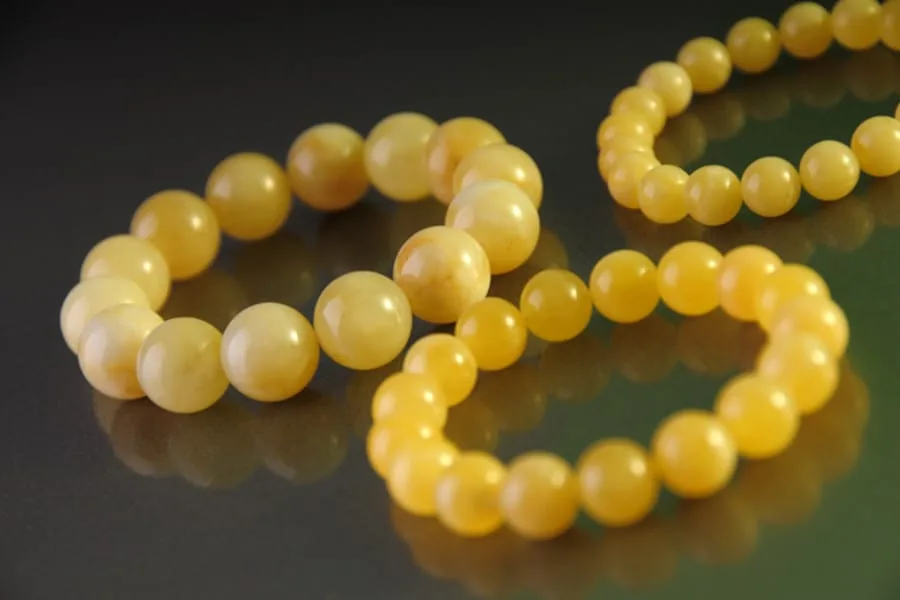
Reconstructed amber is more and more common and arouses more and more interest due to the relatively low price. What is it and how is it created? Does it retain the properties of natural amber?
The so-called amber pressing is a process aimed at fusing small pieces of amber (sometimes even amber powder) into larger pieces suitable for jewellery. It mainly uses high pressure and temperature. Due to the nature of this process, reconstructed amber can no longer be called natural, because only amber that has been created without human intervention and has been subjected to only such operations as grinding or polishing is considered natural amber.
Originally, larger pieces of amber were obtained by sticking small pieces together by heating the matching surfaces. From 1881 both increased temperature and increased pressure were used for this process, and amber made this way came to be called “ambroid”[1]. The process uses well-cleaned natural amber, free of weathered crust and ground to powder. At high temperature and under high pressure the small fractions fuse into one larger form. Amber made in this process is called reconstructed or pressed amber[2].
So how to distinguish between natural and reconstructed amber? It turns out that it is not so easy. The amber subjected to the pressing process in the infrared spectrometry method gives a spectrum such as natural amber. Identification of amber by the FTIR method gives us information only about functional groups that remain unchanged.
Microscope observation helps. Air bubbles in natural amber should be rounded, whereas in reconstructed amber they are flattened, chaotically distributed, irregular in shape and branched. Where the fused fragments of amber join, there will be cracks surrounding lighter areas of completely unchanged amber[3].
Often, the most valued and desirable is the natural, it is no different in the case of Baltic amber. Reconstructed amber is considered to be less noble, which is also cheaper, although at first glance it is practically indistinguishable from a natural nugget. Each product using succinite modified in this way should be marked with a special comment informing the buyer about its character. This obligation lies with the jewellery makers. It is also worth remembering that the wording ‘real’ is not synonymous with ‘natural’ because amber is pressed with real Baltic amber (it gives the same spectrum during testing and retains its properties), whereas due to the ironing process it cannot be said that it is still natural. Therefore, do not be afraid to ask sellers questions if we have any doubts about the goods that interest us.
Sources:
- Kosmowska-Ceranowicz, B., 2013. Amber and its imitations. Warsaw: Sadyba Publishing House.
- Kosmowska-Ceranowicz, B., 2012. Amber in Poland and in the world. first edition edited by Warsaw: University of Warsaw Publishing House.
- Ganzelewski, M., 2003. Bursztyn – materiały zastępcze i imitacje [Amber – substitutes and imitations]. Polski Jubiler, Issue 4 (21), pp. 44-50.
Author: Dominika Skrepnicka