Flowers of Podlasie – the Bondarowski collection
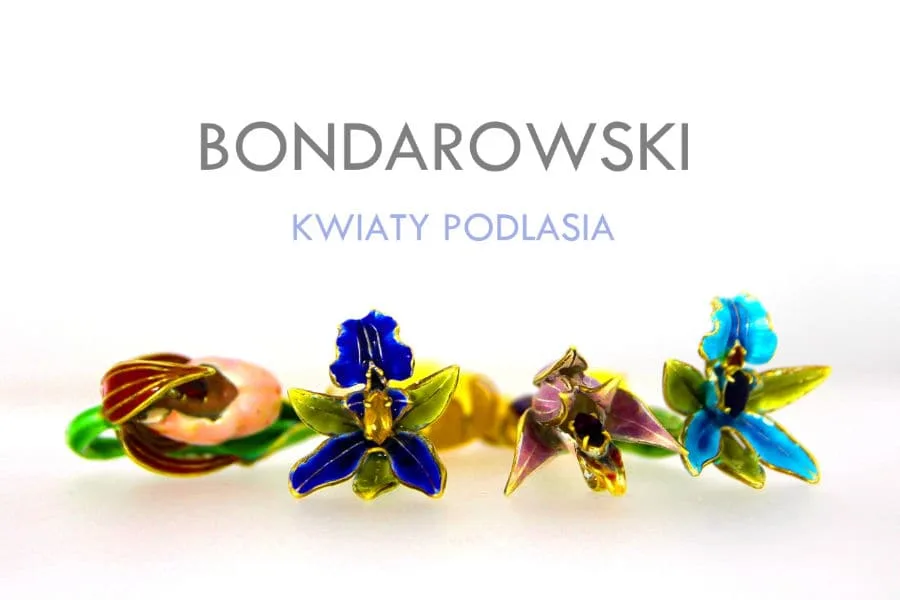
A riot of colour, an Art Nouveau composition and exquisite ornament: a few words about a collection devoted to endangered plant species of the Podlasie region, created by the Bondarowski brand to mark the centenary of Poland regaining independence.
The latest collection of Podlasie flora is a kind of tribute to Polish nature. Although the presented species are “ours”, they seem to be exotic because of the fairy-tale colouring of the enamel decorating the silver surface, variegated natural stones and unique fragments of amber intricately woven into the compositions of the products.
The exhibition of jewellery inspired by Podlasie flora graced the celebration of regaining independence organized by the Embassy of the Republic of Poland in Prague. The musical celebration of this important anniversary was a concert at the Czech National Philharmonic – Rudolfinum perfectly complementing the exhibition “Natural Heritage of Podlasie – endangered species of animals and plants in applied art”.
Mr. and Mrs. Eliza and Krzysztof Bondaruk are an excellent duo of goldsmith artists. In their works they use traditional jewellery techniques – intricately woven filigree and enamelling. This decorative technique was used by the most famous goldsmiths such as Benvenuto Cellini and Karl Faberge. Enamel itself is a sintered glassy coating obtained from powdered quartz with an admixture of metal oxides that give it the desired colour.
Until now, artists have presented in their products exotic flora and fauna as well as human figures carved in rock crystal or amber. In the current collection, next to the Baltic Sea, we find a whole range of coloured stones: lemons, amethysts, pomegranates, olivines and twinkling moonstones.
For Bondaruk, nature is an endless source of inspiration. Many works are decorated with sunny lumps of Baltic amber, which undoubtedly inspires artists.


Podlasie treasures from the collection mentioned above – an ore, a shoe or a popular pansy are available in the collections of Galeria on Św. Jana 2 (at the Amber Museum) and in Galeria Boruni at 60 Grodzka Street.
Author: Karolina Drąg