Methods of extracting Baltic amber
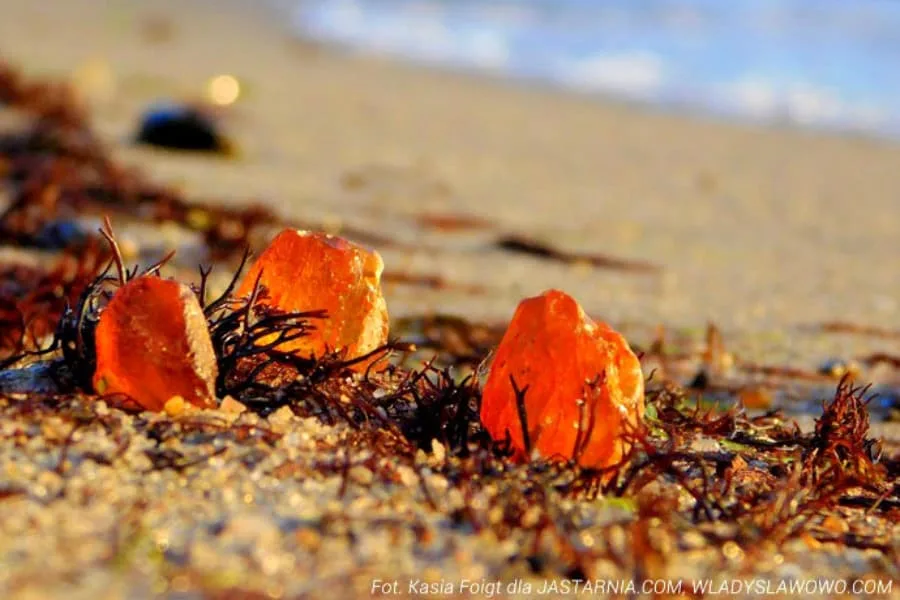
Sunny stone – Baltic amber – is invariably associated with holiday trips to the sea, searching for golden particles on the beach in hot sand in the company of the sound of waves and the screams of seagulls. However, there are other methods of extracting this valuable resource, more about them below!
As early as the 16th century, M. Kromer’s work “Poland, or on its location, people, customs…” mentions amber fishing: “[…] thrown by the waves towards the shore, it is fished out with small nets by naked people wading against the current”. Catching amber with a kaszor (a net fixed to a hoop) straight from the sea was therefore common [2].
Later, in the 18th and 19th centuries, digging through sandy beaches and “rummaging” also became popular – stirring up the sediment on the sea floor with wooden poles so that nuggets of amber stuck there could float up to the surface of the salty sea water. Interestingly, a diving suit was designed especially for amber divers searching at greater depths. Unfortunately, it hindered rather than helped, because of its considerable weight and stiff material – the diver could only stand upright, which was not an efficient position for collecting the raw material [3].
Currently, these traditional methods of obtaining amber are still used. Fishermen dressed in rubber overalls with porridges collect the marine sediment in a net and search the collected material on the shore for amber. The best results are obtained after a storm with a strong wind (more than 7 on the Beaufort scale). Fishing is dangerous, so seekers of this precious treasure immerse themselves in water no deeper than their knees, it requires a lot of patience and a good dose of luck.
Amber is mined on an industrial scale by two methods: open-pit and hydraulic. The first, open-pit mining, involves opening a mine and removing the overburden of barren rock to reach the layers containing Baltic amber. In such mines all the work takes place on the surface, and quite large nuggets of Baltic Gold are found relatively often. Mines of this kind are located on the Sambia Peninsula in Russia and in Ukraine. In Poland amber is not mined this way because the amber-bearing layers lie deeper (~120 m below the surface) than in Russia and Ukraine (~60 m) [1].
The hydraulic method also requires removing the topsoil, but only for technical reasons (overgrown soil would make this method impossible). Next, a metal sheet about 5–6 m wide is driven into the ground to form an enclosure. Inside it, water under high pressure is pumped into the channel; it churns up the soil and washes out the material, which settles on a net stretched across the outlet of the enclosure. The “rubbish” obtained this way (dry plant fragments and other organic debris together with small pieces of amber) is separated in a large container of brine – amber floats on the salt water because of its low density, while the organic debris absorbs water and sinks to the bottom. The main drawback of this method is that larger nuggets cannot be extracted because of their relatively high weight – despite the pressurised water jet, they stay below the surface [1].
Amber deposits are located by studying specialist literature, maps and borehole descriptions, and with geophysical methods, among others [4].
Whatever method is used to obtain amber, it is then sorted by size. The larger the nuggets, the higher the price of the raw material. Nuggets weighing more than 1000 g are rare, and those over 3000 g are considered unique and are valued individually. The largest nugget of Baltic amber ever found weighed 9750 g. It was found in Rarwino, near Kamień Pomorski, and now belongs to the Museum of Natural History in Berlin [1].
Sources:
- Kosmowska-Ceranowicz, B., 2012. Bursztyn w Polsce i na świecie [Amber in Poland and around the world]. 1st ed. Warsaw: Wydawnictwo Uniwersytetu Warszawskiego.
- Kromer, M., 1578/1977. Poland, i.e. on the location, population, customs, offices and public affairs of the Kingdom of Poland, Book Two. In: Olsztyn: Pojezierze, p. 31.
- Popiołek, J., 2001. Pozyskiwanie bursztynu z Bałtyku w dawnych czasach [Obtaining amber from the Baltic in the past]. Polski Jubiler, Issue 3 (14), pp. 41-42.
- Staniaszek, S., 2018. Struktury sedymentacyjne osadów czwartorzędowych wybranych poligonów na Równinie Kurpiowskiej na podstawie badań geofizycznych [Sedimentary structures of Quaternary deposits in selected test sites of the Kurpie Plain based on geophysical surveys]. Warsaw, University of Warsaw.
Author: Karolina Drąg