What do fish and Baltic Amber have in common?
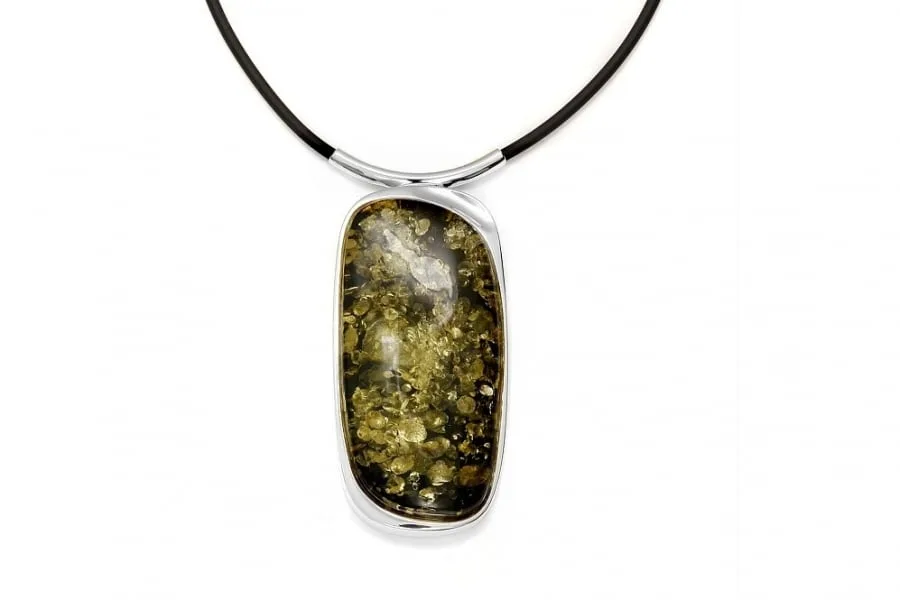
Admiring the Baltic amber jewellery, we are often surprised by the unusual colour, the degree of transparency or the shimmering glitters refracting the light. Where do the mysterious “scales” make amber such a luminous stone come from?
The history of bringing out the natural beauty of Baltic amber is very long. As early as the 17th century, methods of clarifying amber were known: nuggets were heated for a long time in linseed oil, which filled the pores in the succinite and made it more transparent. Heating amber wrapped in paper in a pot of hot sand was also popular[1]. In the second half of the 20th century, amber makers clarified succinite at home in… electric roasting pans! The nuggets were put in the pan and then covered with sand or salt so that they heated evenly. Today nuggets are clarified in an autoclave at increased temperature and pressure. This process produces clear, sometimes even colourless pieces of amber[2]. Cooling the nuggets slowly is crucial to prevent them from cracking[3].
However, when amber is cooled suddenly, so-called “scales“, also known as “sparkles”, form. Inside amber nuggets that cool relatively quickly, micro-cracks appear. The inside of the amber then takes on a shimmering character that catches the eye. But the idea that fish scales are embedded inside such a stone is not true. The similarity of the names is entirely coincidental :) .
Since the 1980s, stones made of two parts have been produced – so-called doublets. The top part is clear lemon-coloured amber, often with so-called “scales”, and the bottom part is a layer of black organic paint that makes the amber look greenish[5]. A similar effect is achieved by treating the back surface of the amber with a flame; it darkens and becomes a perfect background for the scales in the clear amber. With this method the visual effect is much more interesting than with organic paint, because the texture of the bottom layer of the succinite changes and its colour is unpredictable: it may be black, brown or dark grey.
Thanks to minor modifications, we can enjoy the wide spectrum of Baltic amber – lemon, honey, cognac, greenish, white or red amber colours no longer surprise anyone.


Sources:
- Popiołek, J., 2001. Dawni autorzy o klarowaniu, imitacjach i fałszowaniu bursztynu [Early authors on clarifying, imitating and forging amber]. Polski Jubiler, Issue 1 (12), pp. 28-29.
- Wagner-Wysiecka, E., 2018. Mid-infrared spectroscopy for characterization of Baltic amber (succinite). Spectrochimica Acta Part A Molecular and Biomolecular Spectroscopy, Issue 196.
- [3] Gierłowska, G., 2003. Przewodnik po imitacjach bursztynu [A guide to amber imitations]. Gdańsk: Bursztynowa Hossa.
- Kosmowska-Ceranowicz, B., 2012. Bursztyn w Polsce i na świecie [Amber in Poland and around the world]. 1st ed. Warsaw: Wydawnictwo Uniwersytetu Warszawskiego.
- Kosior, M., 2018. Zakaz wystawiania bursztynu malowanego na targach Amberif [Ban on exhibiting painted amber at the Amberif fair]. Gems&Jewelry, Issue VIII, pp. 66-67.
Author: Karolina Drąg