Amber in Ancient Times – Myths and Meaning
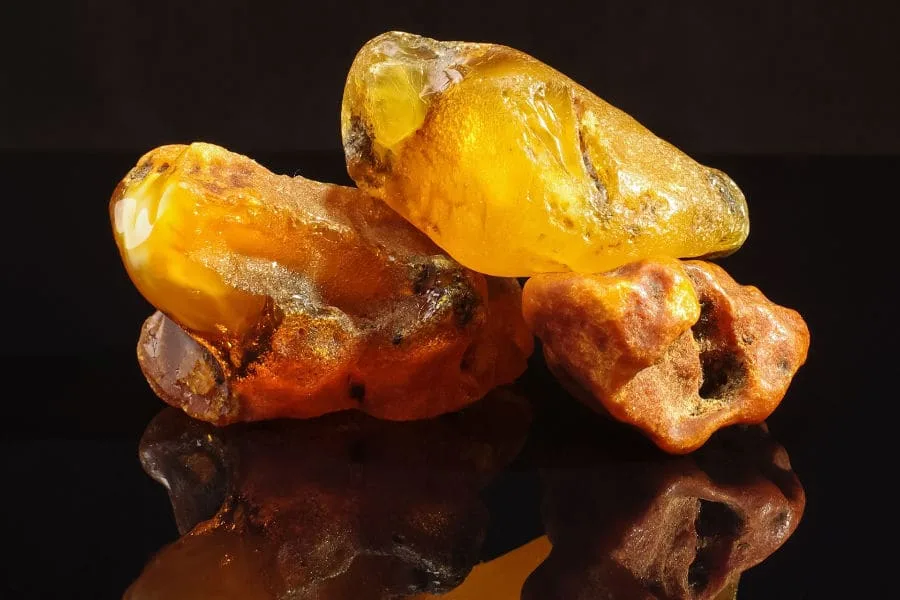
Amber. When we hear this name, we first see a beautiful piece of honey or cognac colour, which later brings to mind a sense of warmth. Then we think – Baltic amber. Despite the fact that our Baltic gold is probably the most famous amber of the present times, and also the most desired, it must be admitted that there is an abundance of resins in the world. About a hundred other ambers or resins have already been discovered, although colloquially all of this – for people before us and for us – is amber. Each culture has its own ideas or beliefs about the history and creation of amber. They often combine their meaning, but they always carry the characteristics of a given culture. Scientifically, all of this has already been explained, but we love to find magic in stories and go back to the times witnessed by ancient people. Back then, amber was a true miracle, magic and a divine attribute. How did ancient people treat amber? What did it mean to them and how much did it mean to them?
It is common knowledge that Baltic amber was used as a valuable raw material in many parts of the world. When visiting our Krakow exhibition Amber. Its beauty and history, attentive visitors learn, among other things, that in ancient times Baltic amber was a means of payment, used for example along the Amber Route, as well as a talisman, an amulet, fuel and even… a reference to the domestic cult of the sun.
However, from the beginning, or more precisely – from the beginning of working with amber…
Greater interest in amber, and in the technique of working it, arose in the period from 400 BC to around AD 400. At that time amber makers used primitive lathes to work the mineral, and this is where the emergence of the Amber Route should be mentioned. People interested in our mineral willingly travelled to distant lands to obtain it, which was linked not only to knowing its potential and its cultural and material value, but also to beliefs. As we know, the route led from the Mediterranean through the Danube basin, Bohemia and Poland, finally reaching the Baltic. As we learn from K. Kwiatkowska’s text Bursztyn w archeologii, in exchange for the raw material our “barbarians from the North” received coins and other everyday objects [1]. This shows how highly amber was valued in the everyday lives of our distant ancestors.
During the period of the migrations (400-700 AD), interest in amber decreased slightly, which in turn weakened the stability of the route, and the raw material did not return to trade until 700-1300 AD [1]. It was then that the Slavic love for amber and making jewellery from it began, which has been unceasing to this day.
Perhaps, despite Christianization, our Slavic ancestors still associated it with the myth of Queen Jurata and her amber palace? It is known that the people living in these areas at that time did not mind cultivating pagan practices in the Middle Ages.
In this regard, it is finally necessary to discuss exactly how amber was associated with divinity long ago…
Amber was often called electron or sunstone, so it is not surprising that it was associated with a form of talisman, which was supposed to bring luck and ward off demons (e.g. in Slavic mythology). That is why it appears as the first mention in the Greek myth concerning the son of Helios – Phaeton.
This myth tells the story of the son of the mighty Helios, who was responsible for the chariot journey across the sky, and thus the journey of the sun above people’s heads. When he finished his ride in the vehicle harnessed by Pegasi, night fell on Earth. His son, Phaeton, wanted to see this journey with his own eyes and asked his father to let him drive the Pegasi on his own. After much persuasion, Helios agreed. When starting the journey, the Pegasi quickly sensed how inexperienced a rider Phaeton was and in their fear they got too close to the sun. The Earth, fearing that it might burn, asked the most important of the gods of Olympus, Zeus, for help. The god’s anger caused the lightning he released to strike Phaeton and the chariot, after which he fell with the animals into the mythical river Eridanus and died there. On the banks of the river, the Heliades, the sisters of the young god, gathered and mourned their loss. The gods decided to take pity on them and transformed them into poplars. It is said that the sisters’ tears turned into amber, or the sap of the trees turned into resin and, together with the river’s current, flowed further into the world [2].
It is also worth mentioning how the ancients saw our raw material in a magical context. Distant times were rich in all kinds of magical practices and witchcraft, and amber was no exception. As an article on ambertic.pl recalls, the ancient Greeks made amulets from amber, associating it with the sun. These objects were meant to protect them from evil spirits.[6] As we learn further: “It was once believed that amber came from the legendary river Eridanos. According to these beliefs, it had its source in the Land of the Hyperboreans, that is, where the real Amber Route ran to the north. “[6] Besides amulets, “Amber in ancient Greece and Rome was burned to obtain a delicate and attractive scent.” [6]
It was Aristotle who first stated matter-of-factly that amber is a secretion of trees, probably pine, which turned to stone over time [3]. Before Aristotle’s accurate conclusion there were various theories, some more fantastic than realistic. One was the theory of Pytheas of Massalia, who claimed that amber was “a strange sea foam solidified into stone”[4]. Another came from Nicias of Athens, who, in truly romantic fashion, believed amber was rays of the sun cast onto the ocean as it set [4]. Finally, after all sorts of theories saying that amber was a secretion or by-product of the metabolism of mythical animals (Zenothemis, a Greek sage), came the famous Roman historian Tacitus, who stated clearly that amber is tree resin [4]. Although this theory, so true, was ridiculed by Agricola (a 16th-century chemist), his contemporary Stefan Falimirz, the creator of Polish botanical nomenclature, firmly sided with Tacitus, writing in his work O ziołach y moczy ich that “amber is the resin of trees”[4].

However, it was not only the ancients who wanted to introduce amber to themselves with various legends, in which they involved their native heroes. After all, no one in Poland has this raw material embedded in their identity like we do. It is therefore not surprising that in our native Slavic mythology we have a story that is both beautiful and sad, concerning amber. It says that at the bottom of the Baltic Sea there was a beautiful amber palace, where the wise and just queen Jurata lived. One day she received a complaint from her sirens that some unwise fisherman had dared to catch too many fish. It should be remembered that for Jurata, who favored fishermen, harmony in the life of the sea was important. The actions of the fisherman named Kastytis therefore angered the queen, who decided to punish him personally. She went to the shore of the Baltic Sea and before she knew it, she fell head over heels in love with the fisherman. She took him with her to the palace, where they lived together in happiness. Unfortunately, the god Perkun/Perun found out about their love and struck the palace with his lightning out of jealousy, causing it to shatter into billions of pieces. Since then, it has been said that the amber blocks are fragments of a beautiful palace, in the ruins of which Jurata remains imprisoned at the very bottom of the sea. There is also a version of the story that says that the ambers are Jurata’s tears cried for her lost lover, who was defeated by the jealous god. In this one, there is a slight reference to the Greek myth and the tears of Heliades, but as is often the case – each country has its own customs, and each story has its own.[5]
The motif of tears in the historical explanation of the origins of amber is often repeated. It also turns out to be useful in Norse tales, where there are mentions of the goddess Freya mourning her husband with tears in the form of amber.[7]
Amber had a different meaning, for example, in Arab countries and Turkey, where it was believed to ward off plagues and protect against evil spells. According to the great scholars of Arab medicine, amber worked primarily as a remedy for hemorrhages and diarrhea, heart diseases and stomach problems.[8] It was most often added to drinks. It was also often used to ward off spells, so we can conclude that it was quite an important element of culture and magic in those regions.
And how was amber spoken of in Kurpie? According to the legends of this group, amber was also tears, but this time of people punished by the flood, who lamented their fate. Interestingly, folk legends took care to explain the diversity of amber varieties, because the colours of tears, and consequently amber, depended on the purity of a given person’s soul. The lighter the amber, the purer the soul and conscience, and the darker the amber, the greater the sins committed.
Here, however, another group appears – the Kashubians, who explained the origin of our treasure in a far more positive way. According to their tales, amber was a divine gift carried by griffins in their claws, and when someone found such a nugget, their troubles or poverty could turn into prosperity.[7] According to Kashubian amber gatherers, nuggets of fossil resin appeared where lightning struck… perhaps divine lightning? Either way, this legend gave rise to the saying Bursztyn zalyskał się (the amber has flashed).
Of course, there are as many legends and truths associated with amber as there are varieties in the world. Each culture that had access to a given resin willingly took advantage of its benefits and tried to explain its origins in its own way. We know both the truth and the legends associated with Baltic amber, but there are still so many resins… And each of them has its own story and tale.
As these examples show, amber is an extremely important raw material not only in the sphere of trade, but also culturally. People from the dawn of time wanted to explain the reason for its creation, its role, the phenomenon. Considered a stone that carries power, a living electron, a sun stone, sea foam, tree sap… Baltic amber was all of this and will probably remain forever a phenomenon that is both magical and constantly fascinating scientifically, whose secrets will be discovered again and again and someone will be delighted by its extraordinary form.
Text by: Anna Ciećko
Sources:
- [1] Kwiatkowska K., Bursztyn w archeologii [Amber in archaeology], [w:] Bursztyn. Skarb dawnych mórz [Amber. A treasure of ancient seas], Oficyna Wydawnicza Sadyba, Warsaw 2001, pp. 25-26.
- [2] https://ambertic.pl/pl/n/31, [dostęp: 25.07.2023r.]
- [3] Mierzwińska E., Dzieje bursztynu. Historia sztuki bursztynowej i przewodnik po wystawie malborskiej [The history of amber art and a guide to the Malbork exhibition], Muzeum Zamkowe w Malborku 1989, p. 12.
- [4] Peczalska A., Złoto Północy [Gold of the North], Wydawnictwo “Śląsk”, Katowice 1981, pp. 11-39.
- [5] Source: https://www.jurata.com/atrakcje/legenda-o-juracie-557 [dostęp: 28.05.2024r.]
- [6] Source: https://ambertic.pl/pl/n/31 [dostęp: 28.05.2024r.]
- [7] Szczepaniak Katarzyna, Geneza bursztynu bałtyckiego [The origin of Baltic amber], Museum of the Earth PAN, (https://mz.pan.pl/wp-content/uploads/2021/12/Geneza-bursztynu-ba%C5%82tyckiego.pdf), [dostęp: 3.08.2024r.]
- [8] Source: https://www.amber.com.pl/bursztyn/bursztyn-baltycki/1764-bursztyn-w-sredniowiecznej-medycynie-arabskiej, [dostęp: 4.08.2024r.]