Amber oil and other amber derivatives
Today we are increasingly turning our attention to all forms of healing, especially natural ones. This is no coincidence: in our constant rush and overwork, our bodies demand a moment’s breath and care for our own wellbeing.
The sciences of herbal medicine, Chinese medicine, naturotherapy, etc. have become popular. The question is – how to relate Baltic amber to this? The answer, as usual, lies in its warm interior, namely in its most famous derivatives. However, the leader among them is amber oil.
Where does it come from? How to use it? What does it help with? These are the most common questions that visitors interested in this topic ask us. It turns out that knowledge about the health-promoting properties of amber is still largely limited to the statement that amber corals treat thyroid diseases. And what about the rest of the wonderful activities to improve our well-being? We lift the veil of this secret so that amber and its derivatives gain more sympathy.
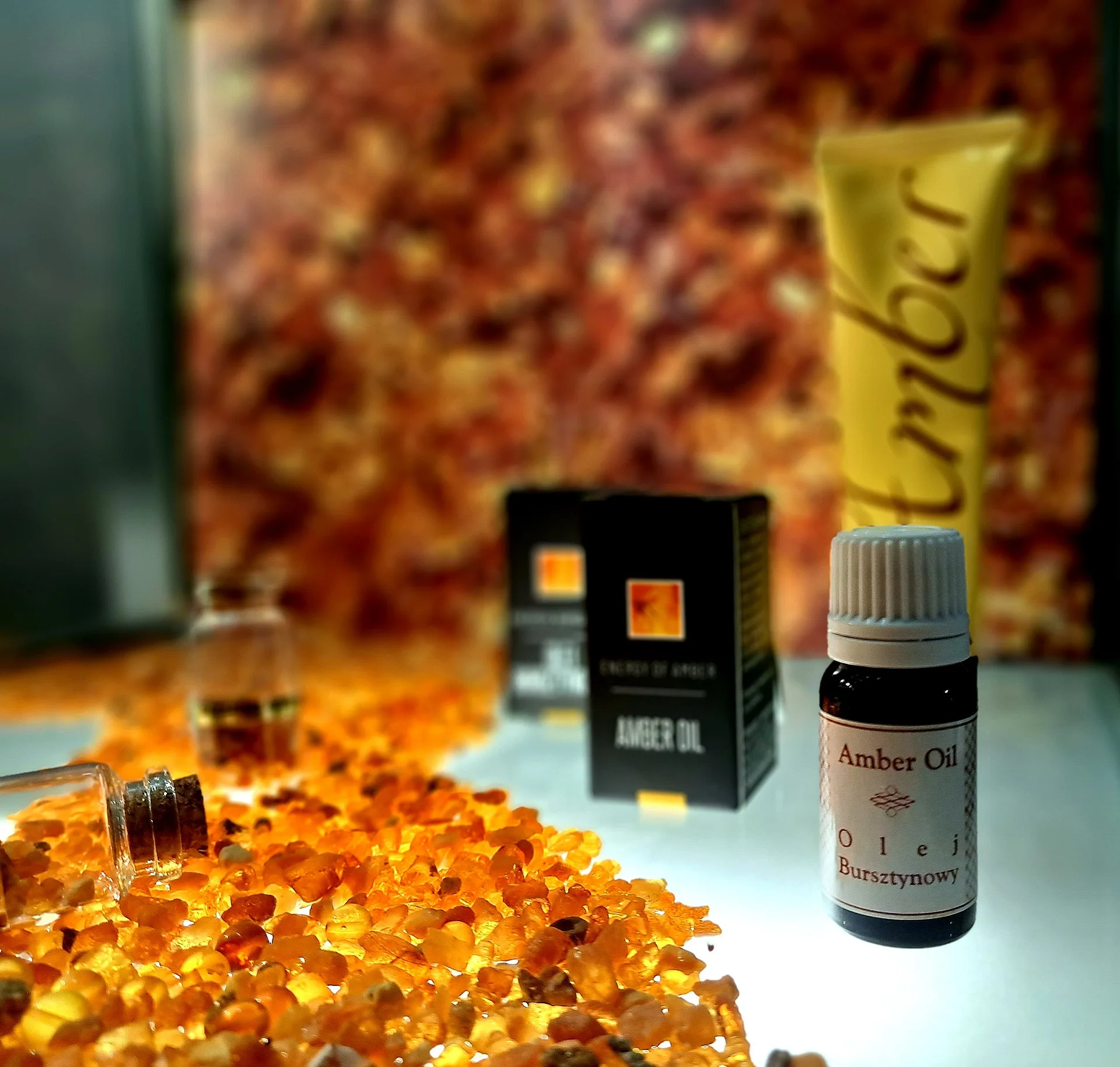
Amber oil is not such an ordinary product. It is a dry distillate of natural amber which, unfortunately, does not always smell pleasant. It is associated with a heavy, camphor-like or simply resinous aroma[1]. This is because the oil is pure, with no other aromas or fragrance oils added. Of course, there are techniques in which the product is enriched with essential oils, such as sandalwood or saffron, to obtain a resinous scent pleasantly reminiscent of amber[2].
How is amber oil obtained? In its purest form it comes from steam distillation, although the process often depends on the producer’s own recipe[2]. As for its appearance, it matches most associations with resin: the product is dark and oily.
What is amber oil good for? Because it spreads easily, it is ideal for massaging sore areas. Its healing properties are also used for bruises and muscle cramps. It also works as an anti-inflammatory and antiseptic for burns, insect bites, wounds and acne[1]. This is because the oil contains oxygen and negative ions, which speed up blood flow in the capillaries and ultimately help the skin tissue regenerate[1]. In the past it was used to relieve the symptoms of tetanus and epilepsy, and even the conditions themselves. What is more, it was used to support the nervous system and improve blood circulation[4].
Amber oil is also known for its calming properties; it is used in aromatherapy or added to baths. It also improves brain function, aiding concentration, and lowers stress hormone levels[3].
As it turns out, amber has a whole range of beneficial effects on our bodies: as early as the Middle Ages, homes were fumigated with burning amber during epidemics as a kind of disinfection. It was a fuel that heated rooms and at the same time, whether the residents knew it or not, disinfected them. Amber oil also has valuable antibacterial properties that help us when we inhale it, for example with a diffuser. It helps clear the upper respiratory tract, soothes inflammation and reduces the production of mucus in the lungs[3].
In addition, scenting the room with amber oil can reduce the effect of stress on the heart and even lower the risk of a heart attack[3].
However, the most interesting application of amber itself in the fight for well-being is the use of various derivatives of our Baltic gold in the care of immunity. How does it work?
Both amber oil (in the form of inhalation and room aromatization) as well as amber tincture and ointment have proven antiviral and antibacterial properties. How it happens in the case of oil – we already know. By inhaling it, we clear our upper respiratory tract and prevent the growth of microbes. How do ointments and tinctures work? Both products are almost salutary for colds or sore spots. Nalewka is an alcoholic solution resulting from the combination of 50g or 100g of amber and an appropriate amount of at least 40% alcohol. Such a tincture is recommended, according to Father Klimuszko’s recipe, to be rubbed into the back or chest when suffering from a cold, but also into a sore spot affected by rheumatism. There is also the possibility of dosing the tincture with a few drops in tea, which affects the internal fight against viruses.
The ointment works in exactly the same way, and because it contains no alcohol and therefore does not dry the skin, it can also be applied around the nostrils to help clear a blocked nose. Manufacturers promise it relaxes muscles and joints tired after physical effort, and our visitors confirm this. Both products have a warming and biostimulating effect. This is because all of amber’s powerful health-promoting substances pass into the solutions mentioned above, including iron, magnesium, potassium and calcium[5].
Health, however, is not only something inside our bodies; it is a state of complete balance, including the world around us. Taking care of a clean environment affects our wellbeing and inner health just as strongly. That is why there are several ways for amber products to work on our surroundings too. One is freshening the air with amber oil, not only with an aromatherapy diffuser but also by simply spraying it indoors mixed with water, for example. It is an easy form of passive inhalation that helps us relax and reduces the amount of bacteria where we work or spend our free time[3].
However, amber is also found in cosmetics – in soaps, creams and hair products. Its moisturizing and softening properties are known in combination with e.g. mud, which has a beneficial effect on the condition of our skin. Shampoos, hair masks, creams and scrubs or bath salts are products that nourish the epidermis and make it better prepared for everyday tasks.
For the pure pleasure of our noses – amber accords are used in the production of perfumes, where they give a sweet, resinous scent to the whole composition. Thanks to this, each such fragrance acquires a significant character.
So why not make use of these wonders that come straight from nature and bring us relaxation and health? A healthy mind in a healthy body – and amber takes care of both, inside and out. Could this unassuming nugget be a remedy for life’s troubles? It is worth finding out on your own refreshed, moisturised, healthy skin and contented inner self!
We invite you to the Boruni Gallery (ul. Grodzka 60) and the Amber Museum (ul. św. Jana 2), where we will treat you with a story about amber in history and medicine, and we will also present its incredible impact on health!
Sources:
- https://amberlyson.pl/index.php?main_page=product_info&products_id=3 [dostęp: 2.02.2023r.]
- Nieumywakin Iwan, Bursztyn na straży zdrowia [Amber guarding your health], Wydawnictwo Vital, Białystok, 2014, p. 87.
- https://porady.interia.pl/kosmetyki/news-wspaniale-wlasciwosci-olejku-bursztynowego,nId,4909441 [dostęp: 2.02.2023r.]
- Barczak Piotr M., Sukcynit. Bursztyn bałtycki skamieniała żywica odkryta na nowo Alzheimer i demencja. Bursztyn bałtycki w nowej perspektywie [Succinite. Baltic amber, a fossil resin rediscovered], SELF-PUBLISHER, 2022, p. 203.
- Leaflet of Amber Ointment from Farmina Sp. z o. o
Author: Anna Ciećko