Blue amber – facts and myths
It is common knowledge that Baltic amber comes in a wide range of colours. Milky, yellow, orange, cognac or greenish shades no longer surprise anyone. Blue, however, is still controversial.
Ambiguous colours, light figures and flickering effects of stones arouse admiration, sometimes in combination with suspicions. Where does this rainbow opal play come from? Why do labradorites and moonstones hypnotize with a mysterious glow? Can natural resins have colours outside the canon of browns and bile? Blue amber also raises curiosity and considerable doubts.
Fossil resin from the Dominican Republic, mined in mountain mines near Santiago, is generally brownish. However, a small proportion of nuggets surprise with a mysterious blue opalescence in sunlight. This happens because sunlight is reflected from the surface of the stone, where ring hydrocarbons split the beam of light, producing a blue colour effect (photo 1). The colour of Dominican resin therefore comes from light effects; it is not its actual colour. In artificial light, nuggets with a blue opalescent tint look no different from other specimens of fossil resin; the effect is visible only in sunlight. The resin comes from an extinct tree species, Hymenaea protera, of the legume family, which grew only in the tropical areas of Central America. The effect occurs not only in nuggets from the Dominican Republic; it is rare, but it is worth noting that it is also found in fossil resin from Mexico.
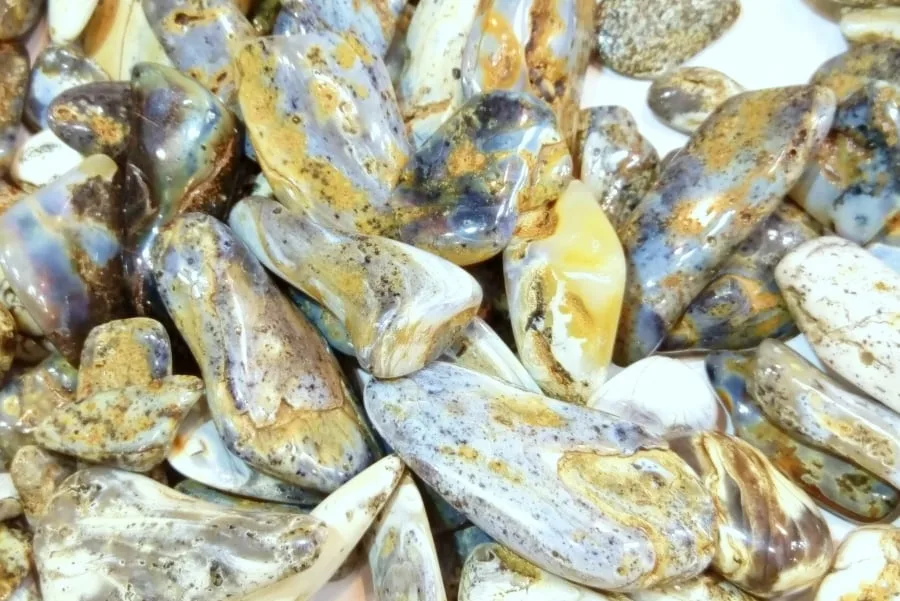
As for Baltic amber, a bluish colour occurs in nature very rarely. The German geologist John Schlee discovered that the blue tint of amber appears when dark particles of pyrite (iron sulphide FeS2) are dispersed in milky-white amber nuggets. This mineral forms in the anoxic zones of the deep seas and oceans. But how did pyrite get into amber? A solution containing sulphur and iron ions seeped into micro-cracks in amber lying on the sea floor, where it crystallised as metallic pyrite.
In the case of scattered pyrite in a fine crystalline form in a milky lump – we see a grey-blue colour (photo No. 2). Pyrite may also appear in thick-crystalline form in the form of clearly visible veins crystallized in the amber voids (photo No. 3). Baltic amber of this colour is extremely rare and very valuable. Sometimes the blue colour of Baltic amber results from the modification – covering the amber with blue translucent paint (photo No. 4). The sale of such modified ambers at the Amberif fair organized by the Gdańsk International Fair SA was banned in 2018.
To sum up: the blue colour of the resin may be the result of natural light effects (as in the case of the Dominican), additional inclusions (pyrite in the gold of the Baltic Sea) or the result of modification processes.

1 - Fossil resin from the Dominican Republic 
2 - Baltic amber with scattered pyrite inclusions 
3 - Baltic amber with a pyrite vein 
4 - Baltic amber covered with blue paint
Author: Karolina Drąg