Cheap imitation or real amber? Succinite verification methods
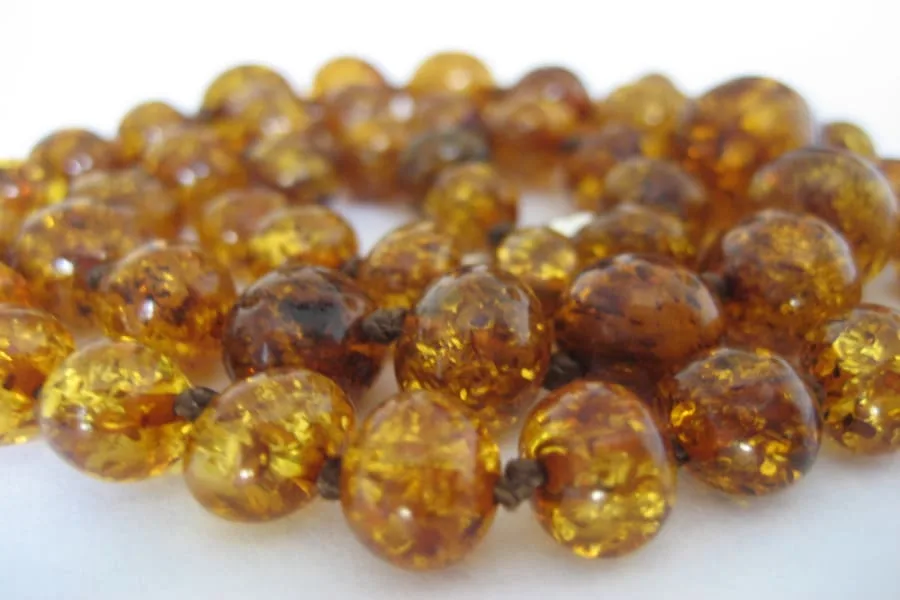
Amber is one of the oldest and most popular materials used in jewellery; what is more, it was the first decorative fossil used on a mass scale in history. It was known in antiquity and was traded by most Europeans living at the time. Amber was transported across much of Europe along the so-called “Amber Route”.
Amber is an element of Polish culture, as evidenced by even the largest exhibition of this mineral in the world, which takes place every year in Gdansk. In addition, Poland is the world’s largest producer of amber jewellery, and our products are popular all over the world. The continuing popularity of “Baltic gold” for centuries, as well as the prestige and quality of amber jewellery, means that there is still high demand for it. Unfortunately, popularity is also an opportunity to trade in artificial amber. So how do you distinguish real mineral from imitation?
Real, natural amber has special physical and chemical properties. Some of them can be easily checked at home and some require specialized tests.
The most important features of amber:
– amber is light, yet heavier than water; amber floats in salt water. So a home test can be the brine method: add salt to water and drop the amber in – it will float. Remember, though, that if your amber has any metal parts, this method will not work.
– the so-called conchoidal fracture – chipped amber resembles the surface of a shell or has a stepped structure.
– another home test is to set the amber alight. Lit amber burns, giving off a characteristic resinous smell. Interestingly, one of the names of the fossil comes from this property: Bernstein, “the burning stone”. Baltic amber should have a nice, pleasant, resinous smell; copals have an intense, aromatic scent, and imitations usually smell like burnt plastic. The resinous smell can also be detected when a hot needle is touched to real succinite, and fine, stringy threads will appear on the needle. The only drawback of this method for testing jewellery is that it damages the piece.
– amber has electrostatic properties, so when it is rubbed with a suitable material, e.g. wool, it becomes charged and can attract small pieces of paper. Interestingly, these electrical properties are reflected in scientific terminology, since the Greek word elektron means amber. It is not an entirely reliable test, however, because plastic rubbed against fabric will also attract pieces of paper.
– Baltic amber is relatively soft – on the 10-point Mohs hardness scale it lies between gypsum (hardness 2.0) and calcite (hardness 3.0). Scratching amber leaves a white line and fine crumbs, whereas plastics form spiral shavings when scratched.
– Baltic amber feels warm and light to the touch; an imitation, such as glass, is usually heavier and cold.
– amber reacts weakly with solvents (e.g. acetone): at first it turns matt but quickly returns to its previous state, whereas imitations quickly turn matt and their surface becomes sticky.
Therefore, there are possibilities to verify the naturalness of amber in home conditions. However, they are not always 100% effective or safe.
One of the most effective and used in the world research methods of succinite and other resins is infrared absorption spectroscopy. In Poland, infrared spectra are obtained by two methods – transmission and reflection.
The Amber Laboratory at the Amber Museum in Krakow uses the reflection method in a spectrometer with an ATR accessory. It is a fast, effective and, above all, non-invasive method of identifying Baltic amber as a raw material and the products made from it. Infrared spectrometry covers the electromagnetic spectrum between the visible region and the microwave region, i.e. between 14,300 and 200 cm-1 (0.7–50 µm). Infrared absorption spectroscopy uses the selective absorption of infrared radiation by different substances. Absorption occurs when the vibration frequency of the infrared radiation equals the natural vibration frequency of atoms or their coordination groups.
The analysis gives a reliable diagnosis of the amber’s authenticity. It is also the basis for issuing a certificate of authenticity. We therefore invite you to buy our certified and, above all, natural products. Our museum laboratory also tests the authenticity of products and provides expert opinions for private individuals, companies, public offices and institutions. We look forward to working with you!