Red Baltic amber – a few words about modification
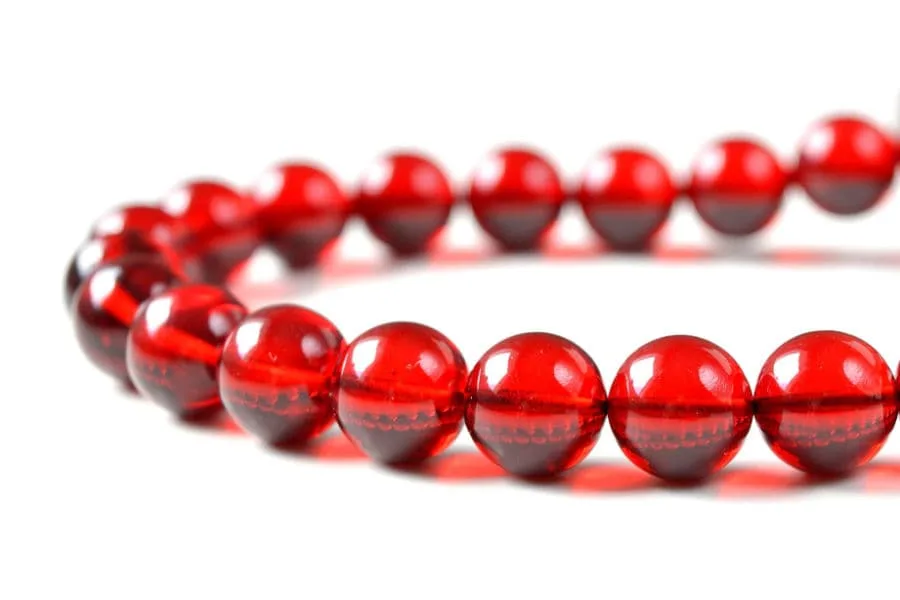
Juicy red Baltic ambers have not been impressed with their clarity and saturated colour for a long time. Some people think of rubies, others like pomegranates – one thing is certain: jewellery with cherry amber looks extremely elegant. But why are they red? You will find the answer later in the article!
The richness of colourful varieties and degrees of transparency of natural succinite make each of the nuggets different and unique – mysterious amber with inclusions, “dappled” contaminated with organic matter, or mosaic with images resembling landscapes enchanted inside.
However, in Poland there is still a myth that amber is not a stone for young people, that jewellery with “Baltic Gold” cannot be fashionable and modern. Fortunately, outstanding Polish amber artists refute this myth with their unique modernist projects.
In turn, manufacturers – to interest amber in a wider clientele – make nuggets more attractive by changing their colour or degree of transparency. Modifications are a response to the needs of the jewellery market. It is worth noting that they do not reduce the value of amber, they only make it more attractive to recipients. Nuggets are visually prettier – clearer, with glitters or in intense colours not seen in nature.
The most popular colour versions of amber resulting from the modification are red and cherry. The change in the colour of succinite caused by human interference leads to the formation of amber called “dyed”.
The modification that turns amber red takes place in an autoclave, at high temperature (up to 250 °C) and pressure (25–40 atmospheres), with oxygen and mixed proportions of inert gases (nitrogen, noble gases) that inhibit the process. The colour changes on the surface of the natural amber as a result of the conditions in the autoclave. If the nugget was pressed (reconstructed) beforehand, the colour changes throughout the whole volume of the amber [1].
Treatments that enhance amber sometimes slightly change its properties (e.g. loss of scent when rubbed, or of luminescence), but it is still Baltic amber [2].
The leading producer of red amber jewellery is the Gdańsk company Progres run by Mr. Janusz Pawlik, whose collections are available in Galeria Boruni on ul. Grodzka 60 and in the Amber Museum on ul. St. John 2.
Sources:
- Wagner-Wysiecka, E, 2018. Mid-infrared spectroscopy for characterization of Baltic amber (succinite, Spectrochimica Acta
- Kosmowska-Ceranowicz, B., 2012. Bursztyn w Polsce i na świecie [Amber in Poland and around the world]. 1st ed. Warsaw: Wydawnictwo Uniwersytetu Warszawskiego.
Author: Karolina Drąg