Report from the exhibition “Amber. Treasure of the Baltic Sea” in the Gliwice Museum
How did Baltic amber end up in Gliwice? What are amber fruits straight from the royal table and an amber Lady with an Ermine doing there, and how did carnival figures from Venice appear? Until 7 January 2024, Villa Caro presents a vision of amber in art, history and culture that is as real as it is fantastic. So if anyone thought amber was boring, here is how wrong they were…

It turns out that amber was long ago like a jewel in the crown of Silesia, whose artists willingly and with extraordinary skill used this raw material in their works. It was also long before a certain exhibition appeared at Villa Caro and decided to change everything.
It might seem that amber’s presence in that region has gathered dust
in the pages of history, but nothing could be further from the truth: amber belongs there just as much as in Krakow, Jarosławiec or Gdańsk. Why? Because it concerns each of us and our hidden love for the history of Poland’s vast lands and regions. All of this is brought together in the historic heart of Villa Caro, part of the Museum in Gliwice, by an exhibition curated by Robert Bartkowski – art historian, museum professional, curator in the Department of Art and Artistic Crafts of the Museum in Gliwice, and a man who is himself a living passion for history, art, culture and… amber!
This exhibition takes an extremely broad approach to Baltic amber
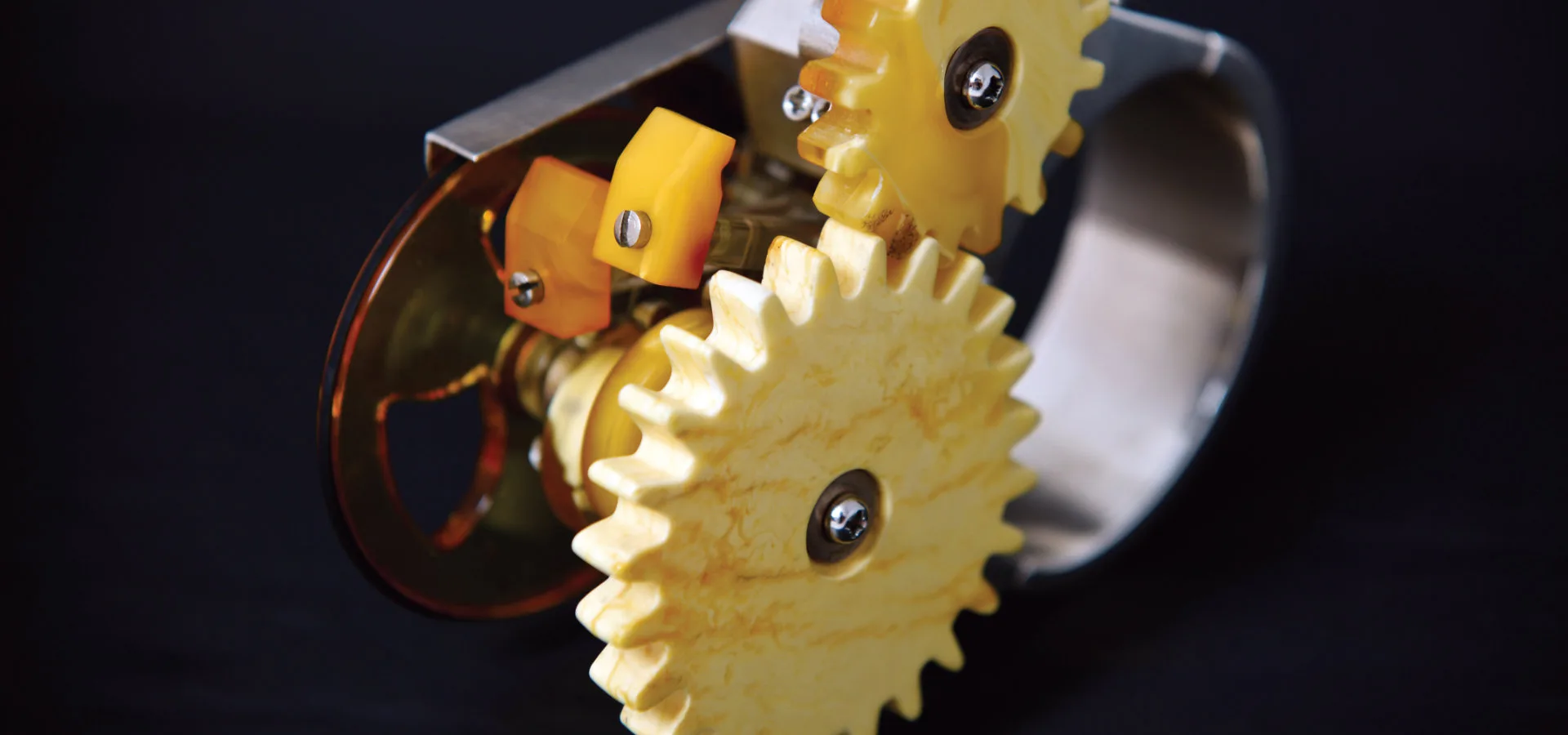
in history – not only the history of events but also that of particular people. Right at the start, two symbols of the exhibition emerge. The first is the myth of Phaethon based on Ovid’s sketches, showing the son begging his father (Helios) for permission to drive his chariot drawn by winged horses, then his thunderous and tragic fall into the river Eridanos, and finally the lament of Phaethon’s mother and sisters over the loss of their son and brother. The second symbol, right beside it, is an extraordinary work by Mariusz Drapikowski, an artist known worldwide for, among other things, the famous Star of Peace in the Grotto of the Nativity
in Bethlehem. At the Gliwice exhibition we see a work heralding a great historic feast: a platter of fruit from the artist’s private collection. It is a sight worth contemplating – human craft and talent, but also the vision and beauty of nature itself.

In the display case: Bernard Salomon LA VITA ET METAMORFOSEO D’OVIDO

The historical themes mentioned so many times are reflected in amber in, among other things, two exceptionally rarely seen objects: the famous kulawka of Sigismund III Vasa (the object is most often associated with that ruler) and an amber pendant, the oldest sentimental jewel, which belonged to Anna Jagiellon and was given to her by her husband, Stephen Báthory (with his own likeness). Thanks to Mr Bartkowski’s invaluable knowledge, you can learn something remarkable about the kulawka and the king’s medallion hidden in it. Who would have thought that the king himself carved his likeness in amber and placed it at the bottom of the goblet? Or perhaps it is only a rumour, and Sigismund III Vasa was not the author of this small amber detail? The truth probably lies
in the depths of historical mystery, and according to the curator, the object will soon return to the treasury of Wawel Cathedral and, perhaps after a short display, disappear from public view. This is therefore a wonderful and at the same time last chance to see this exceptional object, which started the curious practice of breaking the stems of goblets in imitation of the kulawka – a practice that was widely reflected in fashion.

From the right: a sentimental jewel that belonged to Anna Jagiellon
In addition to extraordinary historical artifacts, viewers have the opportunity to see souvenirs truly marked by historical events, including: once belonging to members of the Czartoryski family, and later transferred to other institutions in honor of both the objects and the events in which they took part. Here, for example, a platter with amber plates from the mid-17th century or a copy of the famous and somewhat mysterious necklace of Dorota Sybilla Hohenzollern, Duchess of Brzeg, by Marta Włodarska. Next to it, the photos also show an extraordinary wooden and amber box belonging to the Jagiellonian University Museum (donated by Father Can. Michał Sołtyk).

From the right: a platter with amber tiles from the Czartoryski family collection and a necklace by Marta Włodarska – a replica of the necklace of Duchess Dorothea Sibylle of Brzeg.


Another item that cannot be overlooked in terms of symbolic importance is a knife from the hunting cutlery collection of Klara Isabella Eugenia Habsburg. This is an interesting specimen because it is a never-before-seen combination of ivory and amber at the handle.

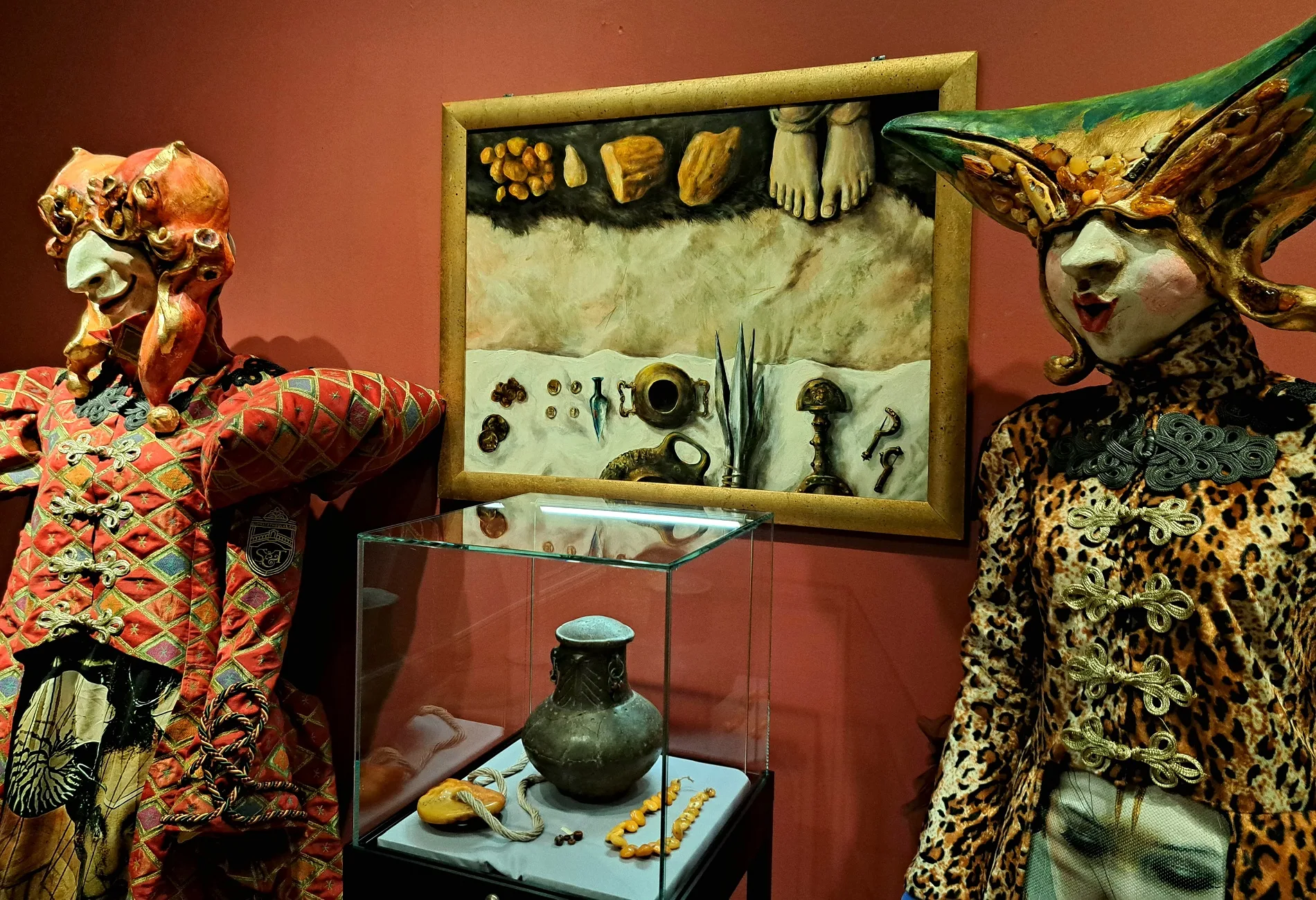
The exhibition is extremely enriched by the colourfulness of two carnival figures decorated with Venetian masks and costumes (women’s and men’s) by Jola Słoma and Mirek Trymbulak and Sergio and Massimo Boldrin’s “La Botega dei Mascareri”. The masks were specially studded with Baltic amber!


We will also see various insects enlarged there, but interestingly – in this part of the naturalia we will learn about the amberoscope by Zbigniew Włodarski. It’s fun for everyone, and therefore good – learning and an idea on how to enchant people with the magic of amber. The natural habitat room also offers close encounters with… a lizard, a buffalo horn, or even a whale vertebrae!

Books are also an important part of the exhibition at its various stages. Small and large books, some acquired from far away and others from Poland, but each mentions amber. For example, there is the Historia Naturalis and nineteenth-century texts on healing stones in which amber appears, almost on the first page.

When talking about amber, even in the context of this exhibition, it is impossible to ignore jewellery. After all, amber is a real decoration! Therefore, we will find here jewellery of great importance for the jewellery and amber world. These are real works of art, both ancient and very modern. The artists whose jewellery we can admire at the exhibition include: Paulina Binek, Dorota Cenecka, Jarosław Westermark, Jacek Baron, Danuta Czapnik, Danuta Kobielska, Giedymin Jabłoński, Wanda and Bogdan Frydrychowicz, Andrzej Boss, Maciej Rozenberg, Arkadiusz Wolski and many other wonderful artists whose jewellery is not only a body decoration. Many times, the viewer can see that it is, above all, a work of art, a demonstration of a true vision and, at the same time, its carrier. Fashion for jewellery, fashion for precious metals, and finally fashion for amber – this is also applied art.


And while we are at it, there are also sugar bowls, napkin holders, teaspoons… And finally sculptures. Among them are Lady with an Ermine, designed by Bogumiła and Marian Kellar and made by Przemysław Kuś, Horse by Krzysztof Jacek Sumeradzki, the Amber Nightingale sculpture by Bogdan Mirowski, Rapture by Mariusz Drapikowski and Paulina Binek’s Myth I and Myth II, which lead into an unusual interpretation of myth.


It is worth remembering that some of these specimens, such as the mentioned lame, do not often appear to visitors, which motivates them to visit the Gliwice Museum and take a closer look at its treasures. As the curator recalls, it was not easy to bring individual monuments to Villa Caro due to their form or symbolic value for culture, but after many efforts it was possible. As a result, we managed to show the unique face of amber and its diversity, which is often emphasized when describing it.
As the curator of the exhibition himself, Robert Bartkowski, says:
There will of course be works from one of the largest museum collections of art jewellery in Poland, held by the Museum in Gliwice, alongside modern pieces by today’s amber artists and goldsmiths from other outstanding collections. Complete variety! The fact that one exhibition shows royal treasures, natural inclusions and the Amber Nightingale statuette belonging to Stanisław Soyka should surprise no one – amber is more deeply rooted in our culture than we think. That is what this exhibition is about, too.
A visit to Villa Caro itself, and to this exhibition, helps you see amber
in a different context – not scientific and not jewellery, although both threads naturally appear. You gain a kind of understanding of amber through how it has been valued for centuries in different forms. Little by little, and then completely, you stop seeing it only as something belonging to the sea, to Gdańsk, to seaside merchants and amber fishers. Amber is simply ours – from Pomerania to Silesia.
Exhibition “Amber. “Treasure of the Baltic Sea” gives the opportunity to take a broader look at our Polish “gold” and wonder – is it still just a stone from which grandmothers made beads? Because after such a feast for the eyes and absorbing knowledge, can you still think of amber as just a stone?
After all, these are chalices, caskets, brooches, platters, medallions, masks, altars, figures… After all, these are raptures and delights, warmth, the sound of the sea, history and cultural history… These are all our treasure that nature has given us. And this treasure no longer belongs only to the sea. Each visitor takes something with them in their thoughts and thus spreads amber further, just as rivers spread it along amber trails thousands of years earlier.

Face urn (Archaeological Museum in Gdańsk);
Neolithic amber necklace (copy, Archaeological Museum in Gdańsk);
Pendant Solar Amulet by Giedymin Jabłoński (Amber Museum – a branch of the Museum of Gdańsk);
Iron Age amber beads (Museum in Gliwice)
Link to information about the exhibition (Museum of Gliwice):
http://muzeum.gliwice.pl/pl/wydarzenia/bursztyn-skarb-baltyku-nowa-wystawa-muzeum-w-gliwicach
(access: December 30, 2023)
(Own photos taken with the consent of the exhibition curator)
Anna Ciećko